
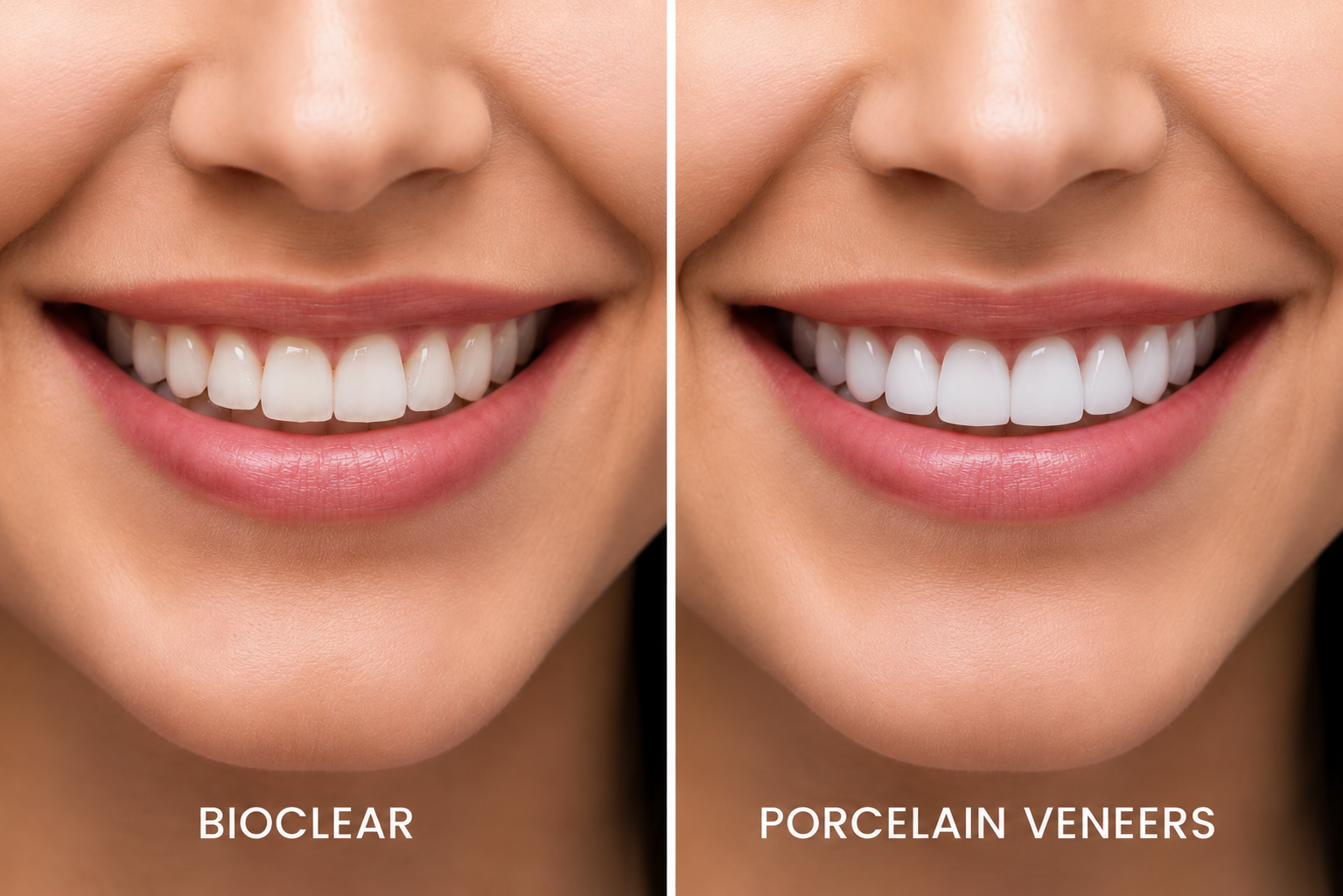
Bioclear vs. Porcelain Veneers: Choosing the Right Fix for Black Triangles
May 20, 2026
Those small dark gaps that appear between your teeth near the gumline — commonly called “black triangles” — are more common than most people realize. Whether they developed after orthodontic treatment, gum recession, or simply over time, they can make an otherwise healthy smile look incomplete. If you’ve been researching options to close them, you’ve likely come across two popular approaches: Bioclear and porcelain veneers. Both can dramatically improve your smile, but they work very differently — and the right choice depends on your specific situation.
At First Hill Dental Center- Dr. Sukhdev Singh helps Seattle patients navigate exactly this kind of decision every day. Here’s an honest, side-by-side look at both treatments.
What Are Black Triangles — and Why Do They Form?
The clinical term is “open gingival embrasures.” They appear when the triangular space between two adjacent teeth isn’t filled by gum tissue. According to the American Dental Association (ADA), this is one of the most frequently cited aesthetic concerns among adult dental patients.
Common causes include:
- Gum recession from periodontal disease or aggressive brushing
- Bone loss that causes gum tissue to pull back
- Naturally triangular tooth shapes that don’t fill the contact point
- Tooth movement after orthodontic treatment
They’re not just a cosmetic issue — open embrasures can also trap food and bacteria, increasing your risk of plaque buildup if left unaddressed.
What Is Bioclear — and How Does It Close Black Triangles?
Bioclear is a minimally invasive composite resin technique developed by Dr. David Clark that uses heated, injected composite material and anatomically shaped clear matrices to reshape and rebuild teeth from the inside out. Unlike traditional bonding, the Bioclear method creates seamless, polished restorations that are remarkably durable and stain-resistant.
Why it works well for black triangles:
- The composite material can be sculpted precisely to fill the open gingival space
- No removal of healthy tooth enamel is required in most cases
- Results are completed in a single appointment
- It’s fully reversible — nothing permanent is done to the underlying tooth
For patients with good underlying tooth structure who want to close gaps without crowns or veneers, Bioclear is often the preferred starting point. If you’d like to explore this option, you can learn more about Bioclear veneers in Seattle at First Hill Dental Center.
What Are Porcelain Veneers and When Do They Make More Sense?
Porcelain veneers are ultra-thin ceramic shells bonded permanently to the front surface of your teeth. They’ve been a cosmetic dentistry staple for decades because of their natural translucency and exceptional aesthetic range — they can change tooth color, shape, size, and length simultaneously.
Where veneers excel:
- Significant cosmetic changes across multiple teeth at once
- Severe discoloration that doesn’t respond to whitening
- Chipped, worn, or misshapen teeth alongside black triangles
- Patients who want a comprehensive smile transformation
The tradeoff: veneers typically require removal of a thin layer of enamel from each tooth — a permanent, irreversible change. They also generally require two or more appointments and a higher per-tooth investment. That said, high-quality porcelain veneers from a skilled cosmetic dentist can last 10–20 years with proper care.
Bioclear vs. Porcelain Veneers: A Direct Comparison
| Factor | Bioclear | Porcelain Veneers |
|---|---|---|
| Tooth Preparation | Minimal to none | Enamel removal required |
| Reversibility | Yes | No |
| Appointments | 1 visit | 2–3 visits |
| Lifespan | 5–10+ years | 10–20 years |
| Best For | Black triangles, minor reshaping | Full smile makeovers |
| Cost | Generally lower | Generally higher |
| Stain Resistance | Good | Excellent |
Neither option is universally superior. The right choice comes down to the extent of the cosmetic changes you need, your tooth health, and your long-term goals.
How Dr. Singh Helps Seattle Patients Decide
During a consultation at First Hill Dental Center, Dr. Sukhdev Singh takes a conservative-first approach. If Bioclear can achieve your goals without touching healthy tooth structure, that’s usually the recommendation. If you’re looking for broader cosmetic changes that a single-tooth fix won’t address, porcelain veneers may be the better long-term investment.
Dr. Singh also considers factors like your bite alignment, gum health, and existing restorations before making any recommendation. Gum tissue health, in particular, matters — closing black triangles over inflamed or receding gums won’t produce stable, lasting results.
What to Expect During Treatment
For Bioclear: The teeth are cleaned and prepared, heated composite is injected into the Bioclear matrices, shaped, cured with a special light, and then polished to a high sheen. Most patients are surprised by how natural-looking the result is — and how fast it goes.
For Porcelain Veneers: At the first appointment, a small amount of enamel is removed and impressions are taken. Temporary veneers are placed while your permanent ones are fabricated in a dental lab. At your second visit, the permanent veneers are bonded and adjusted for fit and bite.
Both procedures are generally comfortable, and most patients return to normal activities the same day.
FAQs
Q1: Can Bioclear completely close black triangles between teeth?
Yes, in most cases. Bioclear uses heated composite resin shaped with anatomically contoured matrices to fill the open space between teeth at the gumline. Results vary depending on the size of the gap and the health of the surrounding gum tissue, but the technique is specifically designed for this application and produces highly natural-looking outcomes.
Q2: Is Bioclear better than porcelain veneers for black triangles?
It depends on your specific situation. Bioclear is often preferred for isolated black triangle closure because it requires no removal of healthy enamel and can be completed in one visit. Porcelain veneers are generally a better fit when a patient also wants to change tooth color, length, or shape across multiple teeth at once.
Q3: How long does Bioclear last compared to porcelain veneers?
Bioclear restorations typically last 5–10 years or longer with proper care, while porcelain veneers can last 10–20 years. Both require good oral hygiene and regular dental checkups to maintain their appearance and integrity.
Q4: Are porcelain veneers painful to get?
The procedure is performed under local anesthesia, so most patients feel little to no discomfort during treatment. Some mild sensitivity in the days following enamel preparation is common but temporary. Your dentist will discuss what to expect before you begin.
Q5: How much does it cost to close black triangles in Seattle?
Costs vary based on the number of teeth treated and the method used. Bioclear is generally more affordable per tooth than porcelain veneers. Since cosmetic dental procedures are typically not covered by insurance, Dr. Singh’s team at First Hill Dental Center can discuss financing options during your consultation.